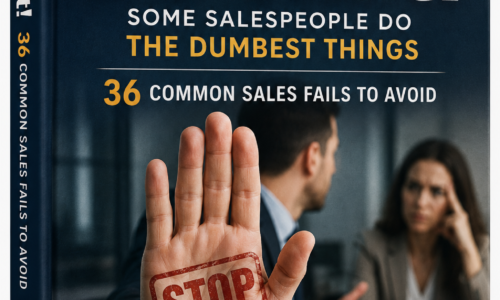

OVERVIEW – Over the past 30 years, I have had the pleasure of working with hundreds of organizations and hundreds of salespeople, some exceptional, some good, and some not so good. In every case, the goal to drive sales and profit was consistent in both the organization and the salesperson. It is common for all organizations and salespeople to share this goal, but what is more common is a lack of corporate strategy or sales philosophy to get there.
With reference specifically to the sales aspect, it is common to have a diverse range of skill sets. In any organization, the philosophy of Vilfredo Pareto typically holds; 80% of the sales will likely be produced by 20% of the team. More importantly, 80% of the company’s profit will be generated by that same 20%. We could then derive that 80% of the team are either under-performers or the 20% are over-performers. While it is likely a combination of both, it is fair to say that the habits of the 20% are more effective. The (bad) habits of the under-performers are those that contribute to a lack of sales success. We could and should focus on the good things that are done in the top 20%; however, it is sometimes easier to stop doing the wrong things and ultimately correct the behavior that way. By eliminating the behavior that contributes to time wasted, poor customer relationships, lost sales and profit, and possibly even your job, your process will become more efficient and more effective.
I have successfully sold in many different companies and industries. In every industry, I quickly learned the products, services, and company goals and sold my way to the number one position (profit and sales) in every company. All of this was done using sound selling fundamentals and techniques that allowed me to fulfill the very simple job description of a salesperson, “to GET and KEEP customers”. Along the way, I made many mistakes but quickly learned from them and offer them for your avoidance in this program “Don’t Do That”.
In addition, I have managed sales teams across the country in very senior positions. There are always good performers, and the mistakes are likely behind them or at least fewer. But there are others that are either learning or have tried to learn and haven’t, and they continue to simply do things that should not be done. Much of the content for this program has also been derived from their shortfalls.
Finally, as a Professional Sales Trainer and Coach, I have facilitated hundreds of training sessions and traveled with many salespeople. I have witnessed things that I still do not understand how or why they happened. They, too, are incorporated into this program.
To summarize, many sales trainers will focus on all the things that you should do to achieve the ultimate goal: close the sale. While I agree that there are many things that you should do, and it certainly makes sense to understand them, I have chosen to present them in reverse by offering over 40 fundamentally bad habits that you should not do during the sales process. Ironically, if you eliminate these things, you will ultimately be doing what you should be.
ABOUT THE COURSE – “Don’t Do That,” written by Jerry Pilkey, is a focused learning program built around the most common—and costly—mistakes made in sales. Each short lesson (1–3 pages) highlights a specific error, explains why it hurts your results, and outlines the corrective actions that top performers use instead. There are 7 sections, each representing a guiding principle to succeed in sales. After each section, you’ll complete an essay-style response designed to reinforce the learning. All essay responses receive personalized written feedback to help you apply the concepts effectively.
Curriculum
- 8 Sections
- 46 Lessons
- 26 Weeks
- Introduction3 Items
- Guiding Principle Number 1 - Develop a "Trust Based Relationship"13 ItemsA “Trust Based Relationship” is defined as “An existing or potential customer that recognizes and understands the added value and superior service provided by you and your organization and reciprocates through loyalty and by paying a higher cost than offered by the competitor for the same or comparable product.........................”
- 2.11. Don’t ever treat a meeting or sales dialogue as anything but professional
- 2.22. Don’t ever make a sale just for the sake of making a sale
- 2.33. Don’t disrespect your competitor
- 2.44. Don’t send anything to a customer/prospect that is not grammatically correct and meticulous in every way
- 2.55. Don’t ever lie or fabricate to your customer
- 2.66. Don’t ever fall short of your commitments
- 2.77. Don’t ever try to sell without intimately knowing your products/services
- 2.88. Don’t ever make your customer wait
- 2.99. Don’t show frustration or anger
- 2.1010. Don’t be someone that you are not
- 2.1111. Don’t try to build rapport with an unknown personality
- 2.12Guiding Principle #1 – Summary
- 2.13Guiding Principle #1 – ASSIGNMENT3 Days
- Guiding Principle Number 2 - Planning and Preparation5 ItemsThroughout my experience working with hundreds of sales professionals, I've observed a recurring and significant issue: a widespread lack of planning and preparation. Many salespeople adopt a "fly by the seat of your pants" mentality.................
- Guiding Principle Number 3 - Time is Your Most Valauable Resource7 ItemsTime is your most valuable asset in sales, with only a limited number of hours each day to achieve your objectives. While having a daily plan is essential.............
- Guiding Principle Number 4 - Go Get Em - New Prospects and Customers7 ItemsCustomer attrition is an inevitable aspect of business, occurring due to factors such as natural turnover, bankruptcies, or competitive pressures. While strategies like vertical integration and internal growth can mitigate some losses.................
- 5.120. Don’t even think about prospecting until you have maximized your current client base
- 5.221. Don’t smile and dial or fail by email
- 5.322. Don’t ever go into a discovery meeting ill-prepared
- 5.423. Don’t end a sales meeting without knowing the next steps
- 5.524. Don’t waste your time on low probability prospects
- 5.6Guiding Principle #4 – Summary
- 5.7Guiding Principle #4 – ASSIGNMENT3 Days
- Guiding Principle Number 5 - Overcoming the Price Objection5 ItemsIn sales, the emphasis should be on demonstrating the unique value you bring to the client rather than on pricing alone. If negotiations are predominantly about price, it often indicates that the client hasn't fully recognized the benefits and solutions you offer................
- Guiding Principle Number 6 - Presenting Yourt Products and Services6 ItemsYou’ve completed the discovery phase by building rapport and asking thoughtful, strategic questions. You've sparked their interest and earned the chance to present your solution...................
- Guiding Principle Number 7 - "Keep Em"7 ItemsYou must be actively prospecting, but the challenging task of growing your business organically can be made easier by simply retaining your existing clients. Have a consistent nurture strategy in place...................
- 8.132. Don’t ever contact a customer without something of value
- 8.233. Don’t take your customers for granted
- 8.334. Don’t be arrogant…..be confident
- 8.435. Don’t give your customer a reason to change
- 8.536. Don’t underestimate your competitor
- 8.6Guiding Principle #7 – Summary
- 8.7Guiding Principle #7 – ASSIGNMENT3 Days
Instructor

Jerry Pilkey has spent more than 40 years helping organizations grow their sales through practical, relationship based selling.
He has trained hundreds of sales professionals and developed the "Don't Do That" sales program to help businesses avoid common sales mistakes and build lasing customer relationships.